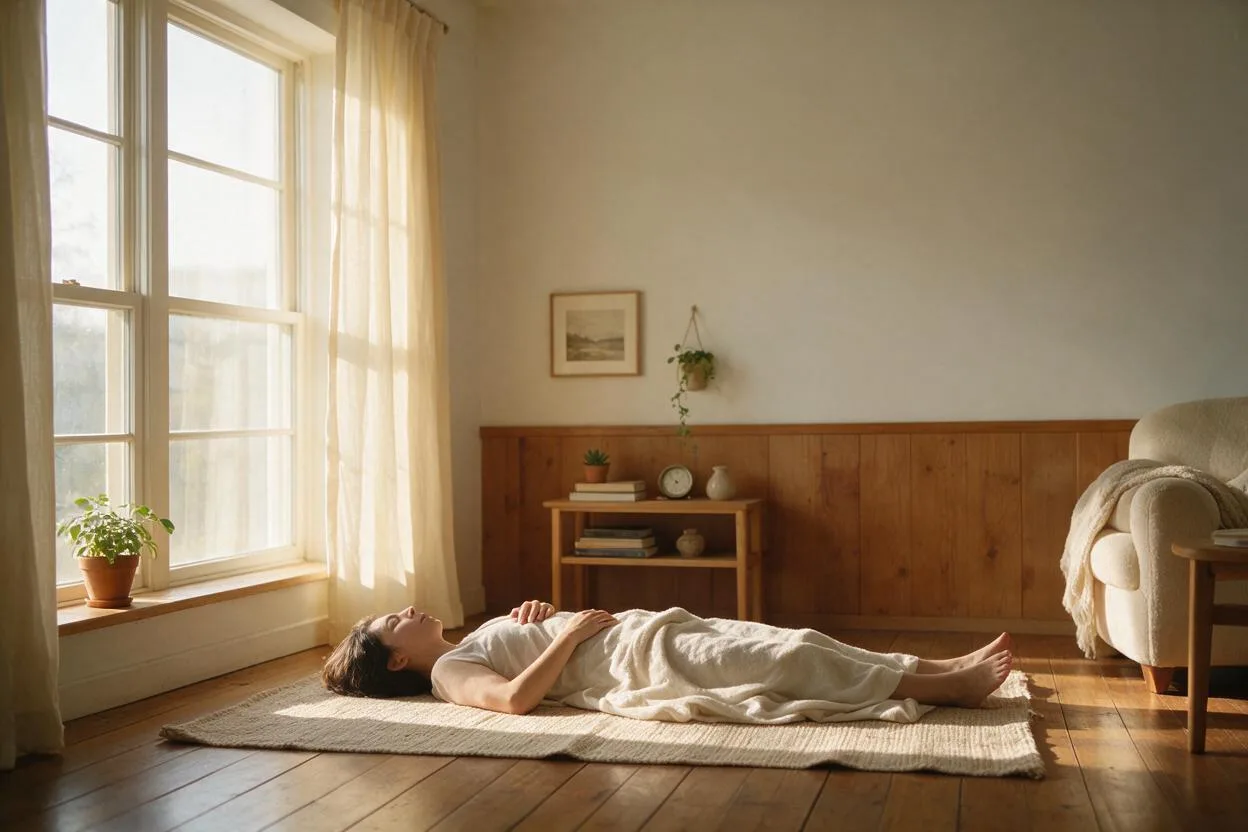
Most of the healing you do will not happen in the therapy hour. It happens in the long stretch of ordinary time that comes after, in a parked car before an appointment, in the pause between one task and the next, in the minutes before sleep when the day finally goes quiet. The session gives you language and a sense of what is possible. The space between sessions is where your body practices living it.
This is not a technique to master or a discipline to keep. It is a small, portable way of returning to yourself when you have a moment and the wish to. Some readers imagine that a practice like this asks for a cushion, a candle, and twenty uninterrupted minutes. It does not. What follows can be done in the time it takes to notice you are holding your breath, and it asks nothing of you that you cannot already do.
Consider a composite picture drawn from many clients. A woman sits in her car outside a building she has to walk into. Her shoulders are near her ears. Her thoughts are running ahead of her, rehearsing everything that might go wrong. She has been told, more than once in her life, to calm down, and the instruction has never once helped. What helps, when she remembers it, is smaller than that. She lets her eyes move around the inside of the car. She feels where her body meets the seat. She lets one breath leave slowly. Nothing is fixed. Something has softened.
That softening is the whole aim here. Not transformation, not a cleared mind, not the disappearance of what you carry. Just a brief and honest signal, sent from you to you, that this particular moment is not the danger your body may be braced for.
A Practice, Not a Performance
It helps to say plainly what this is not. It is not a cure for trauma. It is not a way to force yourself into calm, and it is not a test you can pass or fail. If you try it and feel very little, you have not done it wrong. If you try it and something in you resists, that resistance is information, not a verdict on your effort.
What it is, instead, is a way of building a relationship with your own nervous system. Polyvagal Theory, developed by Stephen Porges, describes how the body is continuously reading its surroundings for cues of threat and cues of safety, mostly beneath conscious awareness. You cannot argue with that reading, and you cannot will it to change. What you can do is offer your body a few gentle, unmistakable cues of the present, and let it draw its own conclusions in its own time.
Approached this way, the practice stops being one more item on a list of things you are failing to do consistently. It becomes something closer to a kind gesture you can extend to yourself, available whenever you happen to remember it.
Orienting to the Room
Begin where you already are. You do not need to sit up straight or close your eyes. Simply let your gaze begin to move around the space you are in, slowly, without hunting for anything in particular. Let your eyes land on a doorway, a plant, the edge of a window, the color of a wall. You might let your head turn as your eyes move, the way it would if you heard your name across a room.
This slow looking is often called orienting, and it is one of the oldest things a body knows how to do. When some part of you is bracing for threat, the visual field tends to narrow and fix. Letting the eyes range widely and unhurriedly is a way of telling the older, protective parts of the brain that there is time to look, and that looking has turned up nothing that requires you to run. You are not scanning for danger. You are letting yourself discover, at the pace of a single breath, that the room is only a room.
If you notice something in the space that you genuinely like, a particular quality of light, a familiar object, let your eyes rest there a beat longer. There is no need to manufacture a feeling. You are simply giving your attention permission to settle on something that is not a problem.
Feeling the Feet
From there, let some of your attention travel downward, into your feet. Notice the places where they meet the floor or the inside of your shoes. Notice the weight of your legs, the pressure of the ground pushing gently back up against you. If you like, you can press your feet down a little and feel the floor meet that press.
When thought is racing, attention tends to gather high in the body, in the head and the throat and the tight upper chest. Deliberately sending awareness into the feet is a way of asking it to come back down, to spread out, to remember that you have a whole body and that this body is being held by something solid. This is contact you can trust. The floor was there before you thought to notice it, and it will keep holding you whether or not your mind is calm.
You can stay here for three breaths or thirty. The point is not duration. The point is the felt fact, arriving in the body rather than the idea, that you are supported right now.
You do not have to feel safe to remind your body that it is safe in this moment. The reminder is the practice. The feeling, when it comes, follows on its own time.
Letting the Exhale Grow Long
Now, if it feels available, let the breath join in. There is no special way to breathe here and no count you must keep. Simply let your next out-breath be a little slower and a little longer than it would otherwise be, as though you were letting a held day set itself down. Let the inhale arrive on its own, whenever it wants to. Then let the next exhale be unhurried again.
You may feel something ease after a few of these. You may feel nothing in particular, and that is entirely fine. The intention is not to breathe correctly or to reach a state. It is only to let the out-breath lengthen when it can, and to notice, without demanding anything, whatever follows.
If focusing on the breath makes you more anxious rather than less, which happens for some clients, leave it alone. Return to your feet on the floor, or to the slow looking around the room. The breath is one door among several, not a requirement, and it is not the door for everyone on every day.
Small Doses, and the Word Optional
Everything here is meant to be taken in small amounts. In Somatic Experiencing, developed by Peter Levine, this gradual approach is called titration, the practice of meeting the nervous system a little at a time rather than all at once. A single long exhale is a complete practice. Ten seconds of feeling your feet is a complete practice. You are not aiming for depth or duration. You are aiming to visit, briefly and often, so that returning to yourself becomes familiar.
The word optional is worth keeping close. On some days, orienting to the room will be plenty and the rest will feel like too much. On other days, you will move through all three and want to stay a while. Both are the practice done well. What you are building is not a streak or a habit you can break. You are building the quiet knowledge that this way back to yourself exists, and that it is always there when you choose to reach for it.
When It Feels Like Too Much
Sometimes turning attention inward brings you closer to what is difficult rather than farther from it. If at any point you feel yourself moving toward overwhelm, toward numbness, or toward a rising you cannot slow, that is a signal to stop and open your eyes wide, and to let the outer world become large again. The framework of the window of tolerance, described by Pat Ogden, names the zone in which the nervous system can stay present without becoming flooded or shut down. Staying near the gentle edge of that window, and backing off when you approach it, is not avoidance. It is wisdom.
This is also where the limits of any solitary practice deserve honesty. Orienting, feeling the feet, and lengthening the exhale are anchors you can genuinely rely on between sessions. They are not a substitute for the relationship in which deeper trauma work is held. If what surfaces when you slow down feels like more than these small tools can meet, that is not a failure of the practice. It is your system telling you the truth about what it needs, and that truth is worth bringing into the room with a clinician who understands both the body and the neuroscience of trauma. None of this is medical advice, and none of it replaces care.
A Small Reminder of Safety
So let this stay small. The next time you find yourself waiting somewhere, or lying awake, or noticing that your shoulders have crept toward your ears, you might let your eyes move slowly around the space. You might feel your feet on the floor. You might let one exhale grow long. Then you might go on with your day, no different on the surface, carrying a little more contact with yourself than you had a moment before.
Healing is not a single arrival. It is the slow accumulation of small returns, one orienting glance, one felt footstep, one unhurried breath at a time.
You do not have to believe any of this will help before you try it. You only have to be willing to look around the room, to feel the ground, to let the breath out slowly, and to see what your body already knows how to do. The practice will still be there tomorrow, asking nothing, waiting for whenever you next remember to come home to it.